

Tuesday, June 30, 2009
Living Off the Wall
When I first heard the news that Michael Jackson died I didn't think too hard about it. Sure I was sad that a person who made such great music and was so beloved by the world had fallen to such unthinkable depths, an agonizing crawl from the absolute height of worldwide fame that could ever be achieved by a human soul to the subject of near constant ridicule and scorn (even until the end though there was constant love). In many ways the person my parents and my older cousins knew growing up had been dead for damn near twenty years, replaced by something that looked very much like a ghost. As much as people my age hate to admit it or try to pretend otherwise (and by my age I mean anyone who was less than 3 when Thriller came out), we didn't really know who Michael Jackson was. By the time we were cognizant, he had already become something of a circus freak. Bad was released in 1987, a few days before I turned 1, and he'd already completely changed his color and his hair. He still made good music, but when I heard or thought about Michael Jackson during my formative years the negative ("I pledge allegiance to the flag, that Michael Jackson is a fag," the "In Living Color" send-up of the "Black or White" video, the child molestation charges) completely outweighed the positive (my cousins VHS of Moonwalker). Not to say that I wasn't completely entranced by the man, even as a little kid. I knew he was important, an outsized celebrity before I even knew what a celebrity was. When I took my test to get into kindergarten and the proctor told me to draw something, I drew Michael Jackson, albeit with an enormous head (anyone who remembers the Speed Demon video from Moonwalker might get why. Needless to say, they said I did not get into kindergarten). But I can't say that I really knew or loved Mike. Not the way my cousins can, not the way the people I saw at the Apollo can. I can love his music, his history and like to the greats from Motown's past, his undeniable genius and enormous talent surrounded by an equally undeniable pain. But his justfiable heyday as the biggest pop star this planet has ever known is an era that I just missed, and it would be dishonest if I mourned him as if I was a front-row spectator for the creation of a legend, when really, I just watched the re-run.
These past couple of days though as every car that passes blares "Billie Jean" and "Beat It" and every other track from his magnum opus out of half rolled down windows, I've found myself gravitating towards songs from "Off the Wall." It's not to be contrary, I enjoy "Thriller" just like everyone else. It's just that, for some reason, when I listen to "Off the Wall," I feel like I'm listening to Michael's last hope. It's well known that Michael was disappointed after the release of "Off the Wall." Although it was critically lauded, he felt that it hadn't been treated with respect by the Grammy's, and he vowed that it would never happen again. When he released "Thriller" he was a man on a mission, to become the biggest and richest pop star the world had ever known. And he did that, it took him three years, but he accomplished what he set out to do. But what was the ultimate cost? Everybody knows how well hindsight can see, but knowing how damaged Michael's psyche was, would it have been better for him and for his life had he not accomplished his ultimate goal? What if he'd been satisfied with the success of "Off the Wall" (and it was still uber-succesful, ultimately selling 7 million copies in the US and having four top ten hits)? "Off the Wall" sounds like pure joy a man has on gaining his independence. "Thriller" sounds like a man on a mission, and the man became ensnared and trapped by the consequences of that mission's successful completion for the rest of his life. My sister said to me that when she looks at a picture of a young Michael Jackson when he was with the Jackson 5, she wants to give him a hug and tell him everything is going to be okay. I want to walk up to the 21 year old Michael after "Off the Wall," won only one Grammy and tell him how great the album was. Maybe we wouldn't get "Thriller," but we also wouldn't get everything that came after it too. Rest in Peace Mike

Monday, June 8, 2009
The Heart of a Slacker
Back in 11th grade, when I was in pre-calculus, I had a teacher who'd give out homework every night. And every night after I came home from work, I wouldn't do it. I'd lay on the couch or watch something on TV or do something useless on the computer, anything but do my homework. There'd always be a rationalization, usually that 6 hours of pushing carts and cleaning up spills was so tiring that there was no way in hell that pre-calculus could get done. Besides, the work was so easy that I could start it in 2nd period general music class and finish as I was walking to third period. Only of course that's never how it worked out. I'd use my dear time in general music unsuccessfully trying to get with this one chick (who ironically I ended up dating a year and a half later) or laying my head down on one of the cold black music stands that I pulled over from the back of the classroom. So everyday, when my teacher would come around to collect the homework, I wouldn't have anything. And she'd look at my with such disappointment. And for the most part, I wouldn't care, figuring that I aced all my tests so at the very least I'd walk away with a B. But one day after class was dismissed, I was the last person left in the classroom. I was putting my notebook in my bag when my teacher walked up to me.
"Antonio, do you know what you're grade in my class is?"
I really didn't have any idea, hadn't really thought about it.
"Right now you have an 84. And you know what, you're capable of having a 104 if you'd just turn in your homework."
And the way she said it, her voice didn't match the look she'd always given me while collecting everyone elses papers. No, it wasn't that almost maternal disappointment she flashed so often, it was a look that bordered on disdain, as if she couldn't fathom a person such as myself. I was like a lazy bug on the bottom of her New Balances. And it was that look and only that look that got me to do my homework, or at least occasionaly. There were still plenty of days where I'd hand in nothing, but they were outnumbered by the ones that I did. Never got that 104, but a respectable 93 was all I could ask for.
Through my almost 23 years on this planet, I've had a lot of teachers disappointed in me, mostly for the same reasons that my pre-calculus teacher was. Like the mid-90's Mariners or the early 2000's Sacramento Kings, somehow the perceived talent never matched up with the finished product. The conclusion I've come to is that deep in my heart, I am a slacker. Now there's a difference between being a slacker and being lazy. I don't think I'm lazy, because laziness implies an unwillingness to work. It is still very possible to be a slacker and still give enough effort to succeed, to appear as if you're working hard and even have results which imply just as much. I think I fall nice and squarely into the latter category, even if only because of the sense of ambition that was driven into me from every adult that's ever meant anything to me in my life. But the ambition I have is also a result of an inherited ego that's way too large for me to be a grocery store philospher (I've known and worked with a few and I envy them). The traditional barometer of success is something that I believe in though, something that I am more than willing to adhere to, for completely vain-glorious reasons (marry a good woman, have a nice bit of money, and have people think of me as intelligent, interesting, and wise). Because truth be told, the best job I ever had was being the mid-day Drug/GM stocker at Kroger. I was the only person in the department, I got a chance to think, I read political magazines and complex novels on my lunch break, I got to interact with coworkers and customers when I wanted companionship, and I got to conveniently disappear when I didn't. If money was not an object, I'd really consider doing that for the rest of my life. Just because you love intellectual discussions and keep abreast on obscure current events doesn't mean you're a scholar. And I know that I'm not, but the expectation is that I should be.
Tuesday, May 26, 2009
City, Country, City
Listening to "City, Country, City" by WAR. Unfortunately I cannot find a link to the song. I'll have to put it on when I get home; they were one hell of a band!
I really think this song should be called, "Country, City, Country." It starts out so languid, tranquil even, the harmonica strong but lazy like a clear sunny day when you have nothing to do. Reminds me of the heat bearing down on me walking up a dry green hill, my feet stomping on grass that's been baked over twice. Only later does it get fast paced, country harmonica gives way to city saxophone. Not that smooth jazz urbane saxophone that frequents every R&B song from the late 80's. I'm talking an urban sax that jolts the senses, crashes into you like the unapologetic businessman checking his BlackBerry down 42nd Street. And just like that you head straight back, to the sun, to something so peaceful. It's hard to choose between the two sometimes and I'm not speaking in a metaphorical sense. My junior year of college I went to this conference where this guy, Peter Raven, talked about how apartment living would make the most economic and ecologic sense; that people would have more green space and be much mroe energy efficient if only we lived like people in say, Hong Kong. And that's true, and I want all that, it appeals to my logical sensibilities and any kind of vision that I have for the world. I want the culture and the subway, the pace and the people, everything that comes with living stacked high on top of millions of other people. But damn it if I don't want a big ass yard to mow and make more even than Steve Harvey's afro. And I want that big ass yard in front of a big ass house with a humongous den where I can hide from my family while watching a baseball game. Everything slowed down to a molasses drip; can absorb everything I love about being alone. All the green space to myself, as energy efficient as a 5-year old Hummer.
F. Scott Fitzgerald said that the test of a first rate intelligence is to hold two opposed ideas in mind at the same time and still retain the ability to function. I wonder if holding diametrically opposed emotions gives one a first rate heart? The thing about Fitzgerald's quote is that I've always found it relatively easy to hold two opposing ideas; I'd argue that it wouldn't be worth having a brain really if you didn't. Rather than impeding my ability to function, debating two opposing ideas inside my head feels utterly liberating. This is certainly because the ideas I end up debating in my head are mostly superfluous. I'm not a lawyer or a judge or some kind of person who has any real responsibility. There are very few consequences to the ideas I play around with.
Emotions though, how you feel about something or someone, that's a lot harder. Whenever they're in conflict I find my entire body shutting down, losing the ability or the will to move, paralyzed by the way I feel or the idiotic things I've done. Maybe it's my body slowing down trying its best to allow my brain to catch up. Maybe if there's just a little more time I can make everything coherent again. I can live with cognitive dissonance when it involves something philosophical like a Supreme Court decision, or hate crimes legislation. But when there's a conflict about how you feel, the ultimate conclusion is that maybe you're not the man you thought you were, the one you pretend to be.
Sunday, May 17, 2009
Adventures in Code Crossing
Sitting here listening to some kind of blend of Aretha Franklin's "Lady Soul," and Van Hunt's classically underrated eponymous first album.
I wouldn't say that it's happened a lot, but there have been a few people who have commented on the way that I talk in the past couple of months. Not the tone of my voice so much, as my vocabulary, my word choice. Being up in New York, I've had a few people comment that I talk like I'm from the South. And while I'm in the South it is generally understood that I am from somewhere up North. Not a full fledged Yankee mind you; maybe Philadelphia or something.
I guess it has a lot to do with fitting in; I've had to do it often- code switching it's called (learned that from an interdisciplinary class that had a foot in the linguistics department). Everyone code switches of course, whether you are moving from a formal setting to a more casual setting, or you are moving from a casual setting with family to a casual setting with friends, our way of speaking changes in marked as well as subtle ways depending on the situation. Code switching is not absolute though, it is impossible to completely change your style of speech. The markers that identify who you are, where you come from, the people you hang around, they always stay with you. When you're trying to fit in they come out subconsciously, sometimes in the most unfortunate situations (like when you're talking nervously trying to impress a suited-up civic leader, that's for another day though). Those who do it best usually can keep those slips to a minimum.
A far more common phenomenon, or at least something I know I do, is the intentional mixing of different styles of speech. I don't know exactly what to call it, but there has to be a term for it in some lingustics text book. For now, let's call it "code-crossing," using at least two separate styles of speech in conversation, at the same time, in order to signify both your insider and outsider status.
"Code-crossing" can be both an offensive and defensive mechanism; I shall give you examples for both.
For the first example, let's take a hard working young man who finds himself at university. And at this university, he takes a class, a class, perhaps, on inner city public school education. And furthermore, having gone to an inner city public school he finds himself surrounded by students who went to Gossip Girl style expensive private schools or at the very least elite public schools. Now, it is true, the young man could discuss the topic, inner city public schools, just like everyone else in the class, using the words and mannerisms and style of an educated man who more than holds his own at this particular institution of higher learning. And he does..... for the most part. But every so often, he puts in a few choice inflections, cuts off a few "g's" at the end of his sentences as he embarks on tales of the woeful inadequacy of his particular high school, a school that symbolizes the inequities within our society. Implicitly, he's saying that it is his right to dominate conversation on this topic. But it's not enough to show that he can hold his own, no, he has to shame his fellow classmates as well.
"Look at you, the advantaged children of the wealthy! I didn't have your advantages and yet we still ended up at the same place; you're pitiful. If I'd gone to (insert fancy private school) they would have named me Chancellor by now. Hang your head in shame!" Offensive code-switching is best used when a dash of outsider status confers some kind of expertise or authority.
Now, let's take the same young man, only this time, let's place him in an entirely different scenario. A fancy dinner, the kind with a bunch of different forks and glasses and courses (yes I know it's a more than a little cliche). Everyone is confidently eating and socializing, using the inner and outer forks correctly, while he has to look down at his hands and make the "d's" and "b's" to remember where his drink and bread goes. In order to save face, code-crossing can be very helpful in this instance also. This time though, it will signal that "Hey I'm an upwardly mobile young man, but back where I'm from, we didn't have all these crazy utensils and cloth napkins and such." Guaranteed to buy you two faux paus before the dinner is over.
The key with code-crossing is it has to be strong to where the message is definitely delivered, but subtle enough where it doesn't seem intentional. It can take years of practice, but with repetition and diligence, in the long run you'll be able to get the effect you're looking for.
Monday, May 4, 2009
Just a Thought About Dreams
To the conscious mind, dreams are pretty much random. I've had dreams about polar bears inside a funhouse, speaking naked at a debate tournament, and my brother getting hit by a car in Beaufort, years after we left, across the street from Alvin Ords because he was breakdancing in the middle of traffic. Anyway, all of those dreams and many more that I can remember had absolutely nothing to with what I'd been going through the days or even weeks before the dream occurred. Now, I'm certain that to my subconscious those dreams certainly did have something to do with my day/feelings/worries and interpreting them in such a fashion is always fun (I briefly tried to keep a dream log). Occasionally though, you have a dream that is incredibly topical, the kind where the moment after you wake up you sit up and let each concrete moment settle in your head- the bits and pieces that are hazy get swept into the dust bin, the most vivid parts taking over the narrative, gradually becoming a compelling story, one now more worthy of interpretation.
The thing about those dreams is that they touch you supernaturally, like an angel visiting softly in the night. Even the most vivid dreams are still ephemeral; in many ways they are the one outlet you have to the mysteries inside your head, the part of you that you have no control over. Topical dreams have helped me make decisions, helped me to appreciate the people I love, solidified my principles, and scared me half to death, much more so than the nightmares I use to have when I was little. At their best, the sense of mystery is awe-inspiring, at their worst completely nerve-wracking. I go through periods where my dreams are incredibly vivid; they strike without warning and last for only a short period of time. I wish I could go through one of them again, just for fun, just to give me something else to ponder when I'm bored with the life that I actually got.
The thing about those dreams is that they touch you supernaturally, like an angel visiting softly in the night. Even the most vivid dreams are still ephemeral; in many ways they are the one outlet you have to the mysteries inside your head, the part of you that you have no control over. Topical dreams have helped me make decisions, helped me to appreciate the people I love, solidified my principles, and scared me half to death, much more so than the nightmares I use to have when I was little. At their best, the sense of mystery is awe-inspiring, at their worst completely nerve-wracking. I go through periods where my dreams are incredibly vivid; they strike without warning and last for only a short period of time. I wish I could go through one of them again, just for fun, just to give me something else to ponder when I'm bored with the life that I actually got.
Saturday, April 25, 2009
Morning Coffee
So I'm by myself in my girlfriend's apartment, drinking coffee, reading the Atlantic. No matter how much I tell myself that I love the hustle and noise, the sounds of my neighborhood, the liveliness of the city, there's nothing nearly as peaceful to the mind as a quiet neighborhood early in the morning on a weekend. Part of it is being alone, part of it is that the people who live here are still fast asleep. Their children are in the living room watching cartoons and the only sounds I can hear besides my hand on the keyboard is the "pop" of a tennis ball awkwardly hitting a racket, and a few songbirds chirping as they chase each other from tree to tree. Maybe it's just the ability to concentrate more than I usually get a chance to. I guess it's connected to all those studies about light and noise pollution. The ways in which the end of night time and the end of tranquility has disrupted our circadian rhythms. Or something like that.
I know it's impossible to have it all three ways- to have the suburbs when I want memories of being a kid playing in the streets on base, the country when I want to be alone with my thoughts, the city when I absolutely crave the excitement. A guy can dream just a bit though.
I know it's impossible to have it all three ways- to have the suburbs when I want memories of being a kid playing in the streets on base, the country when I want to be alone with my thoughts, the city when I absolutely crave the excitement. A guy can dream just a bit though.
Saturday, April 11, 2009
Blogging Howlin Wolf: The Definitive Collection
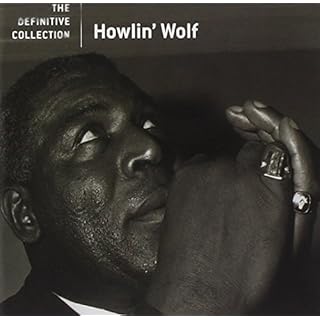
I have been meaning to do this for some time, right after I did the live-blogging for Sketches of Spain. But alas, I just couldn't get another one out of me. Without further ado, here's my live-blogging of the incomparable Chester Arthur Burnett or as he's better known Howlin' Wolf
Moanin' at Midnight
The opening is famous- Wolf does his best impression of throat singing. The song is downright scary, but accessible enough to reach #10 on the charts. Simple lyrics but his voice is clearly the star. An auspcious start to an excellent career.
How Many More Years
Your standard jump blues really, both in subject matter (woman doggin him out, he's about to leave) and in style. Surprising that it was the biggest hit he had in his career, because he's had much better songs. Not to belittle it any, Wolf is great on the harmonica, but his singing on this song is just average, with none of the passion that he'd exhibit on later works. Sounds more like a rock and roll precursor than blues really. As a plus though, a pre wife-beating Ike Turner appears on the song.
Evil-
A song about another man sleepin with your woman, while you're out travelin, workin hard for her. Subject matter thoroughly covered by the blues I know, but it's still so well done. Willie Dixon sings lead on this song and he absolutely steals the show, at least in my opinion. Wolf's relegated to the chorus- which he also does very well on. He really stomps his feet into the "e" in evil, until it's twisted and mangled, like it went through a paper shredder on the way out his mouth. The piano is probably the most distinctive- this song has a more Willie Dixon-style to it even though it was written by Wolf- in the sense that it's sounds more like a pop blues song than some of Wolf's other more unique work.
Forty-Four
"I wore my fourty-four so long, it's made my shoulder sore." Changes up the subject matter slightly, about a man with a gun who has a bad case of wanderlust- a woman has to make an appearance (it wouldn't be the blues if it wasn't) but she's inconsequential to the ending. Instead, he pawns his gun for some money, hopefully to start a new life.
But what this song is actually about is the rhythm section, which really shows its muscles after hiding in the background the previous three three tracks. It all starts with the beautiful piano entrance about 18 seconds in, and then they add some bass and rolling drums to the concoction. Willie Dixon, for all his faults (and we'll get to those in a minute) really could play the bass, it really is the force behind this song. Well, him and Wolf's powerful voice, which is the first time he completely put its versatility on display since "Moanin at Midnight." It's impossible not to hear the southern gospel influences in his voice, it'd sit right along nicely on a Mahalia Jackson tune. And that right there, is the central contradiction of the blues. He's singing about a gun making his shoulder sore with the voice of a choir member (on second thought, maybe it's not such a contradiction).
Smokestack Lightnin
Probably the most famous song of his career, or at the very least the most famous song of his career that he wrote for himself. It wasn't his biggest hit (that was How Many More Years), but it did peak at #8, and in all honestly, it completely blows away that song (it's always good when a song is both an excellent track and becomes a hit, what happened to those days?). The subject matters is, what else, a do-wrong woman, but he doesn't come right out and say it, you're not really sure what smokestack lightnin is. The songwriting is sparse, a third of the words are just Wolf moanin', but I don't think he'd ever put more passion into anything he's done. It's at once dreary and sad, utterly distinctive, the verses aren't really verses, it's more like just a stream of accusatory questions between tormented moans. Like Bobby Womack, he's able to convey strength at the same time he conveys vulnerability. My favorite line is towards the end where he says- "Whoa, who been here baby since I, I been gone, a little bitty boy? Girl be on."
The rhythm section is really cooks again and it's a team effort, the underlying riff would be gorgeous if it wasn't so spooky, particularly the bending guitar that always hits a twinge in me everytime I hear it.
I agree with what Wolf said, he can sing his own shit better than he could Willie Dixon's. Only four more songs on the album were written by him after this. The rest of them are by Willie Dixon- who was much more of a pop-blues writer. I think Wolf's appeal was that, although he was smooth for a 6'6'' 300 pound man, he was naturally rough and intimidating. And he was at his best when he had a chance to experiment and wasn't trying to appeal to his pop sensibilities. At he was successful at it.
As a final aside, the last two songs were the reason that I had such a hard time completing this damn thing, I wanted to hear them over and over again.
I Asked For Water
Another hit for Wolf (#8), but a big drop from the last two songs, which struck the right balance between experimental and accessibility. The musicians, after two Hall of Fame performances, decide to take a break. They're sparse to the point of barely being there. The vocal performance is similarly understated. Not a bad song by any means, but you can't really follow Smokestack Lightnin.
Who's Been Talkin
Tha man is the master of the harmonica. This song is very unique, I can tell why it wasn't a hit, but it has a very interesting lineup, with the tenor sax and piano sounding particularly interesting. The underlying riff by the tenor sax weaves through the breaks and really makes this song. I like how, for the most part, Wolf eschews hooks and instead allows the musicians to be the ones to burrow into your head.
Sitting on Top of the World
A slightly different take on the whole "my woman left me" theme. It may be tongue in cheek, but he seems to relish the freedom from not having to bring his lady with him. Hop on a freight train if he wants, work as hard as he wants and can keep all the cash in his own pocket. The songwriting just okay- but by this time Hubert Sumlin, who Wolf had brought with him from Chicago and who had been with the band from jump, had really come into his own. From this point on, his sliding guitar would be the star musician on just about every track. I like to imagine that Wolf was just a little bored with this song after Who's Been Talkin's originality.
Howlin For My Darlin
And we officially depart from the Wolf-written section into section where Dixon handles the songwriting duties. I don't know exactly why they stopped Wolf from writing his own songs; four of the eight songs above were top 10 hits. Perhaps some of his latest experimentations had fallen flat and blues was moving away from his style. Maybe they thought Dixon had more adaptability. Or maybe Leonard Chess (head of Chess Records) wanted to keep everything in-house and have first dibs to all the rights to the songs. Dixon was handling most of the songwriting duties for all the other Chess artists, and if they were paying the man primarily to write, then damn it he'd write for everyone. It's easy to see where my loyalties lie.
The change from Wolf to Dixon can be immediately felt on this song. First, the title is kind of corny not to subtly playing on Wolf's stage name. There are more bright and shiny horns, the better for the ladies to dance to. And he loses all of his spookiness. Even the subject matter itself has changed- in this song, he is raving about how good his woman is. Who wants a blues artist to do that?
Wang Dang Doodle
The ultimate blues standard, but Wolf had it first. Sadly, he did not do it best. It's known that Wolf hated this song and in his autobiography, Dixon said that he hated this song too. It's a rollicking urban party song, which was something new for Wolf, but he just can't really catch a hold of it. Personally, I like Koko Taylor and Little Walter's versions much better.
On the other hand. Hubert Sumlin is teamed up with Freddy King (the baby of the three blues kings) and they both really go to town. I think it's great that the guitars have fun on this song, but a passionless, flavorless, Wang Dang Doodle is not what I want to hear- he just doesn't have the screeching in his repotoire that's required to make this song great.
Back Door Man
The first time I heard this song I didn't think it was anything special, but I've grown to like it a lot. Wolf's on the prowl in this song, visiting all the wives of the neighborhood men in the night, and retreating to his lair during the day. Reminds me a lot of Clarence Carter's "Back Door Santa." The best part of the song is Dixon's dragging bass, which meets up with Wolf while he sings "I am/ a back door man." It's the intermingling of the bass and guitar that make this song really work though, and Wolf really finds his voice in that combo, around the middle of the song. At times, it sounds almost James Brown-ish, a terse three syllables making up the line in the verse. At times it's almost like improvisation.
Spoonful
Rhythm section sounds like a rehash of Smokestack Lightnin, and it's a bit like 100% recycled paper. No matter what the environmentalist tell you, it's just not as good as the original thing. Freddy King, by this time having taken over chief guitar duties, has another excellent performance. Why did they have Dixon writing the songs again?
Since I don't have much of anything else to say about this song, I guess I'll talk a little bit about Howlin' Wolf's life.
His story starts out like most other bluesman who made their way to Chicago by way of Memphis in the 1930's. Born in Mississippi in 1910, he grew up very poor on a farm near White Station. His mother kicked him out before he was a teenager for being lazy. Then he went to go live with an uncle who treated him even worse, before finally settling in with his father when he was 13. He first moved to Memphis in 1948 after a stint in the army and spent his days performing, being a radio station DJ, and sellling farm equipment. He was discovered in 1951 by Sam Phillips of Sun Records (the same man who discovered Elvis).
I don't know what the perceptions were about Chester Arthur Burnett, but he certainly was no dummy. In fact, he was a something of a rareity among bluesmen. He lived frugally, saving his money rather than spending it on drink, flasy cars, and loose women. Before he even got to Chicago, he'd already saved enough working in Memphis to have a nice nest egg in his pocket and a nice car to drive up in. He couldn't read or write until well into his 40's, but he worked hard, got his GED, and later studied accounting to further his business career.
Most importantly, he married one of those pretty, bougie, southside of Chicago girls. She came from an educated family, was the primary manager of all his finances, and was the one who encouraged him to continue his business studies. (there ain't nothing like a good woman to do that for you). He was so financially successful, that he not only paid his musicians one of the best salaries in the business, but he also paid for their health insurance. That's pretty awesome.
Shake For Me
Up tempo stuff. I do have to give it to Dixon, he does know how to write a popular song. The other good thing about him writing the songs is that Howlin' Wolf got more of a change to play the guitar. Not sure who had the solo on this song but it's enjoyable and Sam Lay puts down a nice backing for the three guitar attack to play over. This is where Dixon is at his best, an ultimiately inconsequential ditty of a song, but very nicely performed.
Red Rooster
Another song that became blues standard. To be honest, I like Sam Cooke's version better, even though he puts a lot of soft sheen onto the song. I guess it's just because I heard Cooke's version first. Not that Wolf's is bad or anything, it's got some downhome feel to it adding a certain heft to the song.
I Ain't Superstitous
Very interesting song, mostly the guitar work again. I miss how great the rhythm sections use to be; but if there's one area that Dixon's songs get the edge it's here. Teamin' with Sumlin, Wolf sure is something. The lyrics touch on an unsuperstitous man who has all kinds of bad luck. Not a woman to be found in this song.
Goin Down Slow
Dixon is a sly motherfucker, the two times he appears on vocals he really takes over. This song he isn't singing, but his spoken word is hilarious "I did not say I was a millionaire, but i said i have spent more money than a millionaire.... and women? well googly moogly) This is some straight classic blues, more great guitar play. At around the 3 minute mark the bending guitar really stands out.
Three Hundred Pounds of Joy
Another interesting uptempo, lots of horns and Buddy Guy (Buddy Guy!) on bass. It's not so much a blues number, more of that 60's poppy R&B stuff. Sounds like something you'd imagine Bobby Bland singing with these kind of lyrics and arrangement.
Built For Comfort
More poppy stuff. I don't mind the silliness too much (I'm built for comfort not built for speed); but the truth is that Howlin' Wolf is long past his prime at this point. I'm still listening, but quite honestly it's starting to bore me at this point.
Killing Floor
Burnett's last hurrah. This final song was written by Wolf, he was finally released from the Dixon cage and he goes back towards the darkness. Not his best stuff, but as we draw to a close, it's nice to hear him going back to his roots. Overall, the first half of the album stacks up to any blues artist in history. The second half is not nearly as good in my opinion, and suffice to say it coincides with when they took the pen out of his hand. Hubert Sumlin's guitar work helps to make up for a lot of it, as does Dixon's penchant for fun- but Wolf knew himself, knew what he was best at. It would have been something if he could have written for himself his entire career and not just half of it.
Subscribe to:
Posts (Atom)